Seiyun, Yemen, is one of the main cities of Wadi Hadhramaut and a natural starting point for exploring this remarkable part of eastern Yemen. Best known for the white Sultan Al Kathiri Palace, Seiyun is also a city of old markets, mud-brick neighborhoods, date palms and historic landmarks that are easy to overlook if you arrive only to continue onward.
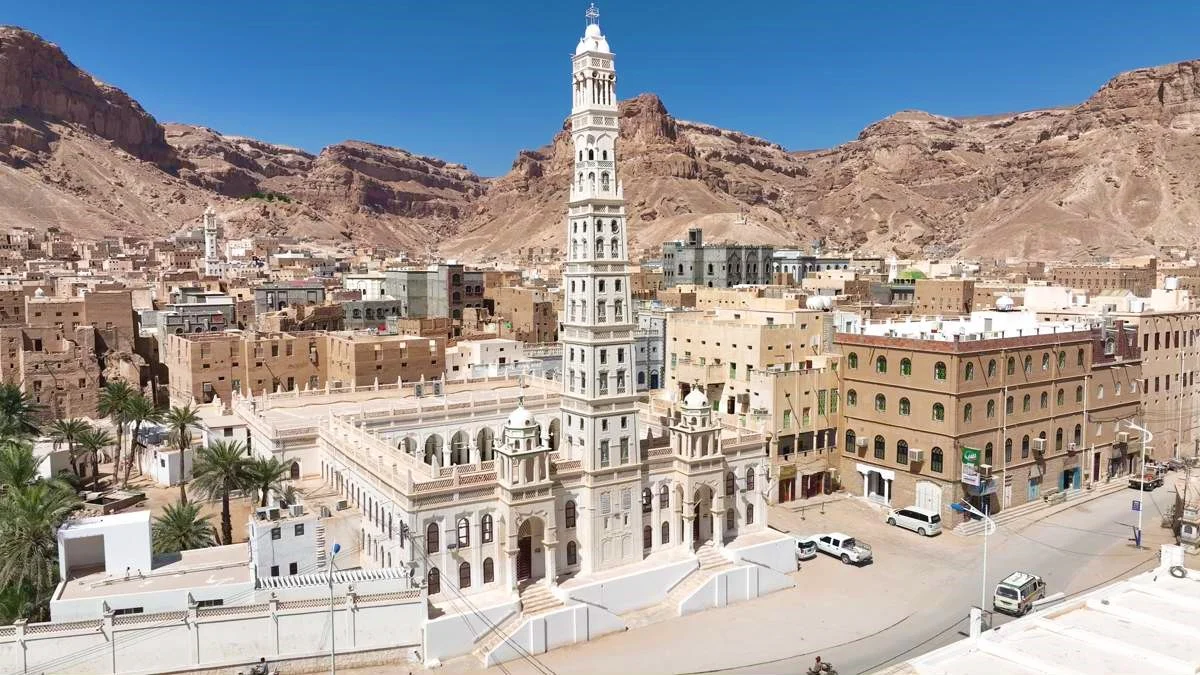
The palace rises above the center of the city, standing in sharp contrast to the brown mountains and earth-colored buildings around it. But Seiyun becomes more interesting once you move beyond its most famous landmark.
Walk through the old quarters, visit Al-Handal Souk, look across the city from Al-Falas Fortress, and the character of Seiyun begins to come together.
For visitors traveling through Hadhramaut, this is often where the journey begins before the road continues toward Tarim, Shibam, Wadi Doan and eventually Mukalla on the Arabian Sea.
Seiyun and Wadi Hadhramaut
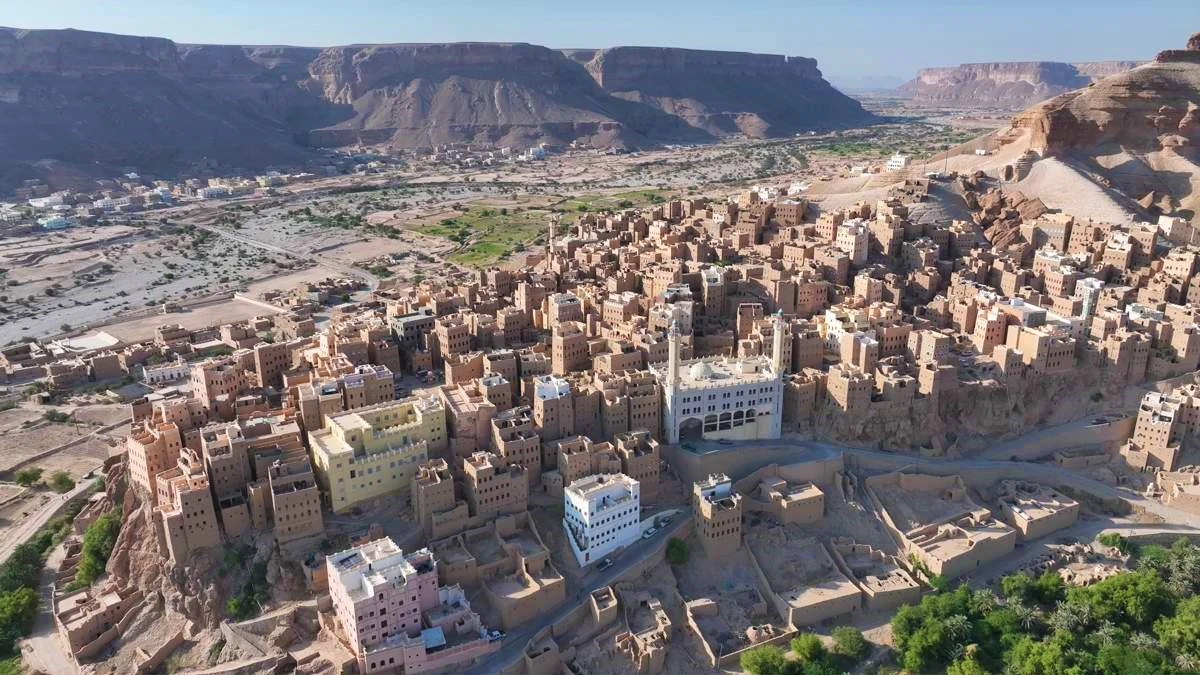
Seiyun sits in the broad valley of Wadi Hadhramaut, surrounded by steep, dry mountains.
Date palms and cultivated land spread across parts of the valley floor, while traditional mud-brick buildings blend naturally into the landscape. It is a setting that appears again and again while traveling through Hadhramaut, but every town has its own character.
Seiyun is one of the valley’s main urban centers and an important starting point for journeys through the region. Tarim lies farther east, while Shibam and other historic settlements can be reached along the wider Hadhramaut route.
Seiyun International Airport also makes the city one of the practical arrival points for organized travel into Mainland Yemen.
For our journeys through Hadhramaut, beginning in Seiyun makes sense not simply because of the airport. The city provides useful context for what comes later: the mud-brick architecture, the landscape of the valley and the history of the Kathiri Sultanate all appear here before taking different forms elsewhere in the region.
Sultan Al Kathiri Palace

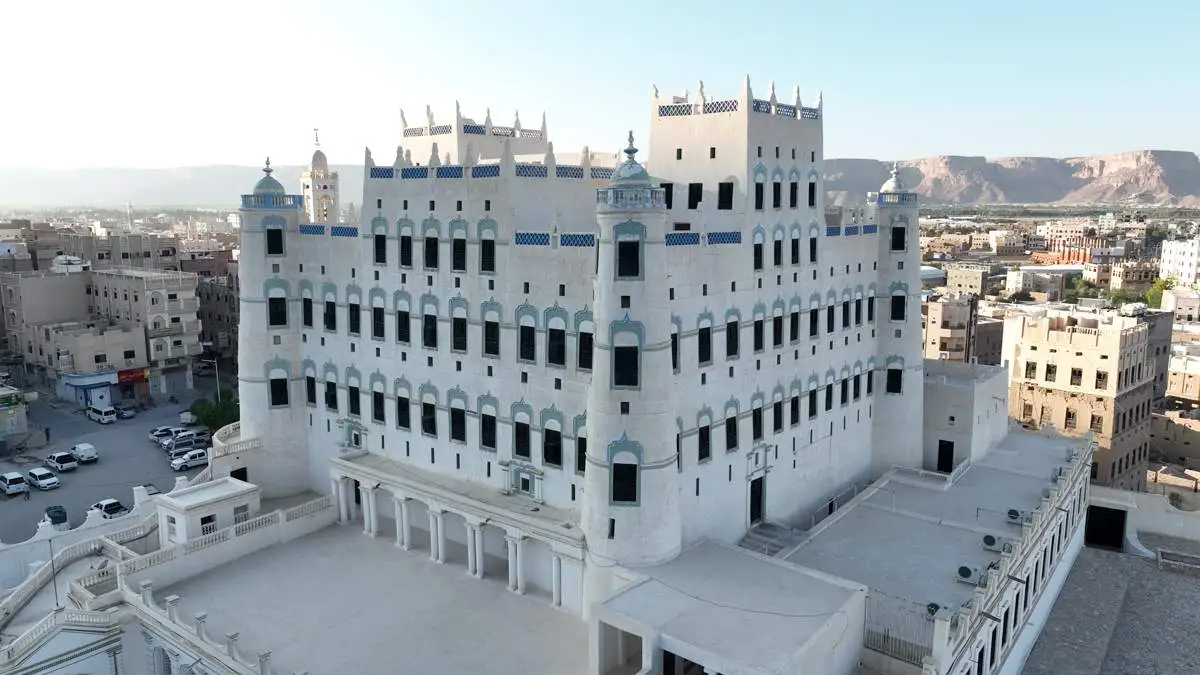
Sultan Al Kathiri Palace dominates central Seiyun.
The huge white building stands on a natural rocky mound, with four corner towers rising above the city. UNESCO’s Tentative List documentation describes the palace as covering roughly 6,600 square metres and rising seven stories, making it one of the most prominent mud-brick landmarks in Hadhramaut.
The palace has a long history connected with the Kathiri rulers of Wadi Hadhramaut. It developed through different periods, with successive rulers expanding, rebuilding and adapting the structure before it took much of the form seen today.
Its white lime-plaster exterior is now one of the defining visual features of Seiyun, standing apart from the earth-colored architecture around it.
Part of the palace houses Seiyun Museum, where collections introduce aspects of Hadhramaut’s archaeology, traditional life and regional history. Displays include traditional clothing, weapons, agricultural tools, jewelry and historic photographs connected with life in the valley.
What makes the building especially interesting is that its design was not only about appearance.
One of its less obvious features is the shamsah, a vertical shaft designed to bring natural light and air into the interior. The palace also uses a traditional internal system for directing rainwater away from the structure — an important consideration in preserving such a large mud-brick building.
These details reveal the practical knowledge behind traditional Hadhrami architecture and the way large buildings were adapted to the climate of Wadi Hadhramaut.
Seiyun Palace and UNESCO
Sultan Al Kathiri Palace has received new international attention in recent years.
On 20 June 2025, Say’un Palace was submitted to UNESCO’s World Heritage Tentative List under cultural criteria (ii) and (iii).
This does not mean that the palace is currently a UNESCO World Heritage Site. A Tentative List identifies places a country may consider nominating for World Heritage status in the future.
The submission highlights the palace’s mud-brick construction, height, traditional wooden windows, ventilation features and its long role in the political and cultural history of Wadi Hadhramaut.
UNESCO has also been involved in rehabilitation work connected with the palace, helping support the preservation of the building and its continued role as a museum and cultural landmark.
For visitors, however, the palace does not need a UNESCO label to make an impression. Its scale and white façade already make it one of the defining sights of Seiyun.
Old Seiyun and Its Historic Gates
The palace is only one part of historic Seiyun.
Older neighborhoods around the center preserve traces of the traditional city, including narrow streets, mud-brick houses and remnants of the gateways that once controlled access through Seiyun’s walls.
One of the surviving landmarks is Saddat Kilabah, the historic northern gate. Local historical sources identify it as one of the principal gates that once gave access to the city.
The gate is easy to miss if attention stays fixed only on the palace, but places like this help explain how Seiyun once functioned as a walled town.
Walking through the older streets also gives a more intimate view of the city’s architecture. The scale is different from the great palace: smaller houses, shaded passages and everyday buildings show how mud brick was used not only for monuments, but for ordinary urban life.
Al-Falas Fortress

Another landmark outside the usual palace-focused description of Seiyun is Al-Falas Fortress.
The mud-brick fort stands on a rocky hill above the Al-Qarn neighborhood, giving it a commanding position over part of the city.
Local historical accounts connect the fortress with Seiyun’s former defensive system, while UNESCO’s Tentative List documentation also mentions Al-Falas Fort among the defensive structures of Wadi Hadhramaut.
For photographers, the fortress is particularly interesting because of its setting. The earth-colored building appears almost to grow directly from the rocky hill beneath it, with Seiyun and the surrounding mountains beyond.
It is a very different sight from the polished white façade of Sultan Al Kathiri Palace, and together the two structures reveal different sides of Seiyun’s political and defensive history.
Al-Handal Souk and Everyday Life in Seiyun
Close to Sultan Al Kathiri Palace is one of the places that gives Seiyun a more everyday character: Al-Handal Souk.
The market has long been part of commercial life in the old city and is associated with traditional local goods, including spices, sweets, nuts, henna and other everyday products.
The market was rehabilitated in recent years while retaining much of its traditional architectural character.
What matters most when visiting, though, is not its age or restoration history.
It is simply a working market.
People come to shop, talk, buy food and carry on with the normal routines of the day. The narrow passages, small stores, spices and local products make it a good place to slow down after visiting the palace.
The contrast works well: the palace tells the story of rulers and political history; Al-Handal Souk shows another side of Seiyun — one built around trade, family life and everyday habits.
Mud-Brick Architecture and Palm Groves
Mud brick is one of the threads connecting almost every stop on a journey through Hadhramaut.
In Seiyun it appears in palaces, forts, old houses and ordinary buildings surrounded by palms and cultivated land.
Travel farther through the region and the same material takes completely different forms.
In Shibam, mud brick rises into tightly packed tower houses. In Tarim, it appears in historic homes, mosques and religious buildings. In Wadi Doan, entire villages seem to emerge from the sides of vast canyon landscapes.
Seeing Seiyun first makes these changes easier to appreciate.
The material may be similar, but the architecture responds differently to each place.
Seiyun for Photography and Documentary Travel
Seiyun works particularly well for photography because the subjects change within a relatively small area.
Sultan Al Kathiri Palace is the obvious architectural landmark. Its white exterior is striking against the brown mountains, particularly when palms or older buildings are included in the frame.
Al-Falas Fortress creates a completely different composition, with mud architecture blending into rock and mountain.
Then there are the quieter scenes: streets around the old neighborhoods, Al-Handal Souk, date palms, small shops and daily activity.
For anyone interested in a Yemen photography tour or Yemen documentary tour, these everyday scenes can be just as valuable as the major monuments.
On our Hadhramaut routes, we try to leave room for this side of Seiyun rather than treating the city simply as an airport and palace stop.
Photography of local people should always be respectful, and permission should be requested when appropriate.
From Seiyun to Tarim and Shibam
One reason Seiyun works so well at the beginning of a Hadhramaut journey is its position within the valley.
From here, the route continues east toward Tarim, a city known for its religious heritage, mosques and distinctive architecture.
Shibam brings another dramatic change. Its mud-brick tower houses rise closely together from the valley floor, creating one of Yemen’s most recognizable skylines.
From the central valley, the journey can continue toward Wadi Doan, where the scale of the landscape changes again. Villages cling to canyon walls or sit high above the wadi floor.
Eventually the mountains open toward Mukalla and the Arabian Sea.
Seen as one journey, these places make more sense together. Seiyun introduces the architecture and landscape of Hadhramaut before each later destination develops the story in a different direction.
How Long Should You Spend in Seiyun?
For most first visits, half a day to a full day is enough to see the main parts of Seiyun.
That allows time for Sultan Al Kathiri Palace and Museum, Al-Handal Souk, parts of old Seiyun and other stops before continuing deeper into Wadi Hadhramaut.
Those interested in photography, architecture or local life may want longer, particularly if they want to photograph the city at different times of day.
Seiyun also works naturally as the first overnight stop after arriving in Hadhramaut.
Best Time to Visit Seiyun
The most comfortable period for traveling through Mainland Yemen is generally from mid-September to April.
During these months, temperatures are better suited to sightseeing across Wadi Hadhramaut than during the hottest part of the year.
Morning is particularly good for markets and street activity. Later afternoon brings softer light around the palace, mud-brick buildings, palms and mountains.
Arriving in Seiyun
Seiyun International Airport is one of the arrival points used for organized journeys into Hadhramaut.
TourYemen’s Mainland Yemen itineraries commonly begin in Seiyun before continuing through Tarim, Shibam, Wadi Doan and Mukalla.
Because airline schedules and routes can change, current flight options are better confirmed when planning a journey rather than treated as permanent information in an evergreen travel guide.
International travel through Mainland Yemen also requires advance organization, including the tourist visa process, security clearances, approved routes, transportation and local coordination.
Plan Your Yemen Tour
Seiyun deserves more than a quick arrival before heading elsewhere.
Sultan Al Kathiri Palace may dominate the skyline, but the old neighborhoods, historic gates, Al-Falas Fortress, Al-Handal Souk and palm-filled valley reveal much more about the city.
It is also the beginning of a wider story.
From Seiyun, the road connects Tarim, Shibam and Wadi Doan before eventually reaching Mukalla and the Arabian Sea, bringing together very different landscapes, architecture and chapters of Hadhrami history.
TourYemen includes Seiyun in selected private and group Mainland Yemen tours, with the necessary travel arrangements coordinated in advance.
Contact TourYemen and begin your journey through Wadi Hadhramaut in Seiyun.